Quick Answer
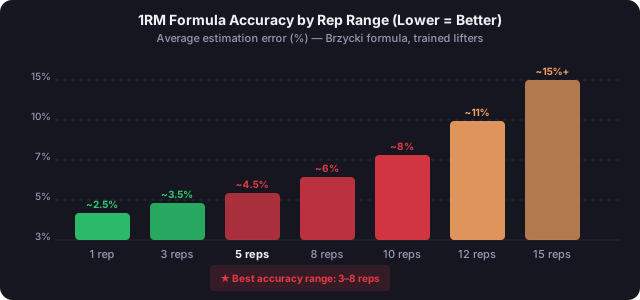
The Brzycki formula estimates 1RM within 3–7% for most trained lifters in the 1–10 rep range. Accuracy drops significantly above 10 reps. RPE-based estimates are comparable to percentage-based methods when calibration is accurate, typically within ±5% for experienced lifters.
The Promise and the Limits of 1RM Estimation
Every strength program eventually asks the same question: how strong are you, really? Tested 1-rep maxes are accurate, but they're also exhausting, require perfect conditions, and can't happen every week. So coaches rely on estimated 1RMs instead, back-calculated from submaximal sets. The question is: how much do you trust that number?
With the right formula and careful RPE rating, your estimated 1RM is accurate enough for practical programming. That's conditional on two things: you're training in the rep ranges where the formula was validated, and you're rating RPE honestly. Get either wrong and the estimate drifts.
The Formulas Researchers Actually Test
Over the past 40 years, exercise scientists have proposed and tested dozens of 1RM prediction equations. The most widely used in strength sports are:
Brzycki (1993): e1RM = weight ÷ (1.0278 − 0.0278 × reps). Performs best from 1–10 reps.
Epley (1985): e1RM = weight × (1 + reps ÷ 30). One of the oldest, commonly used in gym tracking apps.
Lombardi (1989): e1RM = weight × reps^0.10. Slightly more conservative than Brzycki.
Mayhew et al. (1992): e1RM = weight ÷ (0.522 + 0.419 × e^(−0.055 × reps)). Most accurate in the 5–15 rep range.
A 2019 meta-analysis in the Journal of Strength and Conditioning Research compared 12 1RM prediction formulas and found that no single equation dominated across all rep ranges. For 1–5 reps, Brzycki consistently performed among the best. For 6–15 reps, the Epley and Mayhew equations showed slightly lower mean error. Above 15 reps, all formulas became unreliable.
This calculator uses the Brzycki formula because it's best validated in the rep ranges where RPE-based training is most commonly applied: 1–8 reps for strength work, and up to 10 for moderate-load sessions. Calculate your estimated 1RM here.
How Accurate Is "Accurate Enough"?
In practical terms, a 3–7% error on a 1RM estimate means:
That's a real spread. The catch is that your true 1RM isn't fixed either. It fluctuates by roughly 5–10% day-to-day based on sleep, nutrition, hydration, and accumulated fatigue. Even a percentage-based program built on a recently tested max is working with a moving target.
This is exactly why RPE-based loading has gained traction. Instead of computing a percentage of a number that changes daily, you target a specific effort level and let the day's readiness determine the absolute load. The 1RM estimate from our Reps in Reserve calculator isn't intended to be a definitive number, it's a calibration tool.
What Drives Estimation Error
Several factors pull your estimated 1RM away from your actual maximum:
Rep range: The further you get from a true maximum effort, the more the formula extrapolates. A set of 3 reps at RPE 9.5 gives a much tighter 1RM estimate than a set of 12 at RPE 8. Stay in the 3–8 rep range for your most reliable estimates.
RPE calibration: This is the biggest source of error for self-estimated 1RMs. If you rate a set as RPE 8 when it was genuinely RPE 9 (one fewer rep remaining than you thought), your calculated 1RM drops by roughly 3–5%. Consistent calibration errors compound across a training block. Beginners are most susceptible, a 2021 study found that novice lifters underestimate RIR by an average of 1.3 reps, leading to systematically deflated 1RM estimates.
Exercise selection: The Brzycki formula and similar equations were validated primarily on compound barbell lifts, squat, bench, deadlift. They're less reliable for machine exercises, isolation movements, or exercises with significant skill components like the Olympic lifts.
Individual variation in strength-endurance relationship: Some athletes are more "fast-twitch" and lose strength rapidly as reps increase. Others maintain more strength at higher reps. The formulas assume an average population, individual deviations can push estimates 5–8% in either direction.
Improving Your 1RM Estimate Reliability
Use the right rep range. For maximum accuracy, derive your estimated 1RM from sets of 2–5 reps. These are close enough to maximal effort that the formula extrapolates minimally.
Validate quarterly. Every 8–12 weeks, test your actual 1RM under good conditions, well-rested, well-fed, fully warmed up. Compare it to your running estimate. If your formula consistently overshoots by 5%, apply a 5% correction factor to your future estimates.
Cross-reference multiple sets. Rather than basing your programming on a single estimated 1RM, average the estimates from your last three to five working sets. This irons out day-to-day RPE rating variation.
Log RPE ratings immediately after each set. Delayed ratings are consistently less accurate. Even 60 seconds of rest changes your perception of how hard the set was.
Use a consistent RPE definition. Decide whether you're rating to technical failure (form breaks down) or absolute muscular failure (can't move the weight at all). For most strength athletes, technical failure is the correct standard. Apply it consistently and your calibration stabilises faster.
Our powerlifting RPE calculator applies the Brzycki formula automatically. The more consistently you use it, same exercise, same rep ranges, same RPE standards, the better your running 1RM estimate will track your actual strength. It's not perfect, but over an 8–12 week block, the trend is far more useful than any single test.
The Bottom Line on 1RM Accuracy
Expected error for well-calibrated RPE-based estimates: 3–5% in the 3–8 rep range. For beginners still learning to rate effort: expect 7–12% until calibration stabilises around weeks 8–12 of consistent RPE logging.
For practical programming, an estimated 1RM within 5% is more than good enough. The difference between squatting at 80% of a 310 lb estimate (248 lbs) versus 80% of the true 300 lb max (240 lbs) is 8 lbs, well within the margin of a 2.5 kg plate adjustment. Stop chasing the perfect number and start logging consistently. The trend over time matters far more than any single estimate.