Quick Answer
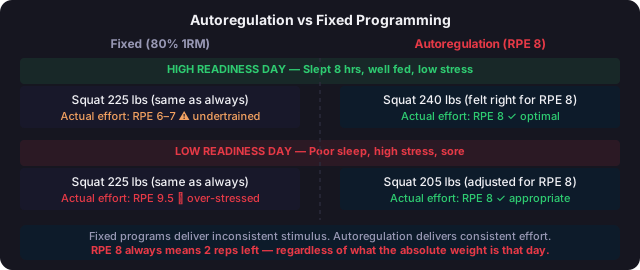
Autoregulation means adjusting training intensity based on daily performance readiness rather than following a fixed script. The most practical method for strength athletes is RPE-based loading, where effort level (not absolute weight) is prescribed. Research shows it produces equal or better strength gains with lower injury risk than fixed-percentage programs.
What Is Autoregulation?
Every training program, no matter how well designed, faces the same fundamental problem: it was written in advance for a theoretical version of you. The version that slept eight hours, ate well, isn't fighting a cold, and didn't have a brutal week at work. Real training happens in the real world, where those conditions are the exception rather than the rule.
Autoregulation is the practice of adjusting training on the fly to match your actual readiness on any given day. It's been studied in sports science since the 1970s, and in strength training specifically, it's become the dominant training philosophy among evidence-based powerlifting coaches at organisations like Barbell Medicine and Reactive Training Systems.
The most practical implementation for strength athletes is RPE-based training. Our RPE calculator is the first tool you need to get started.
The Research Foundation
The science of autoregulation in strength training is younger than the practice, but it's growing fast.
A foundational 2011 study by Mann et al. in the Journal of Strength and Conditioning Research assigned collegiate football players to either a traditional fixed-percentage program or an autoregulation program using repetitions to failure as the daily readiness indicator. After 6 weeks, the autoregulation group made significantly greater gains in squat (13.2% vs 8.0%) and bench press (3.5% vs 1.5%).
The 2016 Helms et al. study used RPE specifically as the autoregulation method and found that RPE-based loading produced strength gains statistically equivalent to percentage-based loading, while participants in the RPE group reported lower training stress and fatigue across the 8-week trial.
A 2021 systematic review published in Sports Medicine examined 17 studies on autoregulation and found consistent evidence that it reduces injury risk and increases long-term adherence compared to fixed-load programming. The review authors concluded that autoregulation is "particularly well-suited for intermediate to advanced athletes who have the self-awareness to accurately gauge their training readiness."
How RPE-Based Autoregulation Works in Practice
The basic implementation is straightforward: your program prescribes an effort level (e.g., RPE 8) rather than a percentage, and you determine the appropriate weight for that day based on how the bar is moving.
The warm-up serves as your readiness test. Before your first working set, take note of how your warm-up weights feel. If 60% feels like RPE 5 (as it usually should), you're primed for a normal training day. If it's grinding at RPE 7, reduce your working weights 5–10% and set your RPE expectations accordingly. You can still have a productive session; it just won't be your heaviest.
Working sets provide daily calibration. Each working set gives you a data point. After completing a set of 4 reps at what you rate as RPE 8, plug those numbers into our Reps in Reserve calculator to get your estimated 1RM. Compare it to your running average. If it's significantly below average (>5%), your readiness is low and your volume that day should reflect it. If it's running high, you have room to push.
The session adjusts as it progresses. Autoregulation doesn't happen once per session; it's an ongoing process. If your first work set feels harder than expected, reduce the load for subsequent sets. If it feels easier, add weight. The goal is to land within half a point of your RPE target across all working sets, not just the first.
Implementing Autoregulation Without Overcomplicating It
One mistake lifters make when switching to autoregulation is overthinking it. They spend 15 minutes deciding whether a set was RPE 7.5 or RPE 8, adjust weights obsessively between sets, and leave the gym more mentally exhausted than physically trained.
Keep it simple:
Round to the nearest 0.5. Rate your sets in increments of 0.5. RPE 7, 7.5, 8, 8.5, 9, 9.5, 10. Finer gradations than that are measurement noise, not useful data.
Use consistent weight increments. Don't try to dial in 3.5 lbs. Adjust in 5 lb (2.5 kg) jumps. If your first working set felt like RPE 7 when you wanted RPE 8, add 10 lbs for the next set. Clean, simple adjustments.
Trust your first-set rating over subsequent sets. By the third or fourth set, accumulated fatigue makes everything feel harder. Anchor your day's load selection to your first working set RPE and maintain that weight (or slightly reduce) for remaining sets. Don't keep adding weight to try to hit the target RPE as you fatigue.
Keep a training log. This is non-negotiable for autoregulation. Without a log, you have no baseline to compare against. After 6–8 weeks of consistent logging, you'll have a personal RPE profile that makes accurate self-assessment much faster.
Who Gets the Most Out of Autoregulation
Intermediate lifters (1–5 years of consistent training) benefit most. By this stage, your technique is solid enough that fatigue doesn't dramatically distort movement patterns, and your training history gives you enough context to calibrate effort accurately.
Advanced competitors use autoregulation most sophisticatedly. A competitive powerlifter might run a largely autoregulated program through their general preparation phase (GPP) and switch to more tightly controlled percentage-based loading only in the final 4–6 weeks before a meet.
Lifters with variable training schedules, anyone who can't always control sleep, work stress, or travel, get outsized benefit from autoregulation because it stops them from grinding through training sessions that would be better taken at reduced intensity.
Complete beginners are the one population where autoregulation is harder to recommend as the primary tool. Beginners don't yet have reliable effort perception, and fixed-progression programs (like a basic linear progression or 5×5) provide clearer feedback on progress. Start with structure, then layer in RPE awareness as a secondary metric.
Getting Started This Week
You don't need to overhaul your entire program to start benefiting from autoregulation. A simple entry point looks like this:
After 6–8 weeks, you'll have a baseline. At that point, you can start making small autoregulation adjustments: if a session's working weight feels easier than expected (RPE landing 1 full point below target), add 5 lbs. If it feels harder, hold the weight or drop slightly.
That's autoregulation. It doesn't require a new program, a coach, or special equipment, just honest effort ratings, a training log, and a calculator to convert your working sets into projected 1RMs. Give it a try on our homepage with whatever working set you hit last session.