Quick Answer
RPE (Rate of Perceived Exertion) in strength training rates how hard a set felt on a scale from 6–10, where RPE 10 = nothing left and RPE 8 = 2 reps remaining. After each set, ask yourself: "How many more reps could I have done?" That number subtracted from 10 is your RPE.
What Is RPE and Why Lifters Use It
The first time most people hear "RPE 8" in a powerlifting context, they nod politely and have no idea what it means. That's fine. Rate of Perceived Exertion sounds academic, but the underlying idea is simple: instead of being told to squat a fixed weight, you're asked to squat at a specific effort level. You control the weight; the program controls the intensity.
RPE in strength training was popularised by coach Mike Tuchscherer at Reactive Training Systems, and it's built around one question: how many more reps could you have done if you pushed to absolute failure? That number, called Reps in Reserve, or RIR, defines your RPE. RPE 10 means zero reps left. RPE 9 means one rep left. RPE 8 means two reps left. Simple as that.
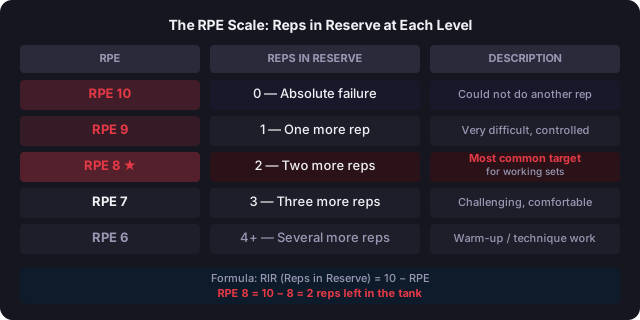
The RPE Scale Explained
The full scale used in modern powerlifting programming:
Most productive training lives between RPE 7 and RPE 9. Below 7, the stimulus for strength adaptation is typically insufficient. Above 9 every session, cumulative fatigue spirals out of control quickly.
Why Beginners Struggle with RPE (and How to Fix It)
Most new lifters are genuinely bad at rating RPE, and it has nothing to do with toughness or experience in other sports. They'll hit an RPE 7 set, feel winded, and call it an RPE 9. Two sessions later, a real RPE 9 sneaks up and they blow straight through it into failure because their calibration was off. It's not a character flaw. It's a skill gap, and like every skill gap, it closes with focused practice.
The core problem is that RPE requires knowing what failure actually feels like, and most beginners haven't pushed to failure consistently enough to have that reference point. They stop sets because the weight feels heavy, not because they've genuinely run out of reps.
The fix is deliberate practice:
Your First Week Training by RPE
Let's walk through a concrete example. Say your program calls for: Squat 3×5 @RPE 8.
Warm-up: Work up gradually. Bar × 10, 50% × 5, 65% × 3, 75% × 2. Each warm-up set should feel like RPE 5–6 at most.
Working sets: Load up to a weight where you think 5 reps will leave 2 reps in the tank. If you're not sure, start conservatively. Better to land at RPE 7 and add weight than to hit RPE 9.5 and be fried for the remaining sets.
After your first set, rate it honestly. Did it feel like 2 reps were left? If it felt like 4 reps were left, add 5–10 lbs. If it felt like you barely made the 5th rep, drop 5–10 lbs.
Logging the session: Write down: 185 lbs × 5 @ RPE 8 (estimated). At the end of the week, look back. Were you consistently within half a point of target? If your RPE 8 kept coming in at RPE 7 or 9, adjust your loading strategy next week.
Using the RPE Calculator to Learn Faster
One of the fastest ways to accelerate RPE calibration is to use a calculator after every set. Our RPE calculator takes your weight, reps, and RPE rating and returns your estimated 1-rep max. Track that number over time.
If your estimated 1RM jumps around wildly week to week when your actual strength hasn't changed, your RPE ratings are inconsistent. If your estimated 1RM trends upward steadily, two things are happening: either you're getting stronger (great), or your RPE calibration is improving and you're loading heavier to match the actual target effort level (also great).
For example, if you squatted 185 lbs × 5 at what you rated as RPE 8, our Reps in Reserve calculator would estimate your 1RM at approximately 218 lbs. Log that number. Next week, if you squat 190 × 5 at the same RPE 8, your estimated 1RM should come out slightly higher, evidence of real progress.
Common RPE Mistakes New Lifters Make
Ego RPE: Rating a set as RPE 8 because you want it to be heavy, not because you actually had 2 reps left. This is the most common mistake and leads to underloading.
Fatigue RPE: Rating a set higher because you're tired, not because the rep count is genuinely lower. The third set of squats will always feel harder than the first. Rate based on reps remaining, not how wrecked your quads feel.
Inconsistent failure definition: Some lifters define failure as technical failure (form breaks down), others as absolute muscular failure. Pick one and stick to it. Most coaches use technical failure as the standard.
Skipping warm-up calibration: Your first heavy set of the day isn't a reliable RPE indicator because everything feels harder when you're not fully warmed up. Use warm-up sets to calibrate, if your 70% warm-up moved fast and smoothly, your working sets can be loaded confidently.
When to Start Using RPE
If you've been training seriously for at least 6 months and your technique on the main lifts is reasonably solid, you're ready to start learning RPE. Earlier than that, the feedback loop is too noisy; you're still learning motor patterns, and rating effort is a separate skill on top of an already difficult task.
Start by rating your existing percentage-based sessions. Keep your current program, but add an RPE log alongside it. After 4 weeks, compare your ratings to the prescribed percentages. Over time, you'll develop a personal RPE-to-percentage relationship that makes future autoregulation much more accurate.
When you're ready to fully switch over to RPE-based programming, the strength training RPE calculator on our homepage is the first piece of kit you'll need. Free, no sign-up, and it starts generating your calibration dataset from your very first working set.