Quick Answer
RPE-based training adapts to your daily readiness and is more sustainable long-term; percentage-based training offers simplicity and structure. Most intermediate and advanced lifters benefit from RPE. Beginners often do better starting with percentages.
Two Schools of Strength Programming
Every serious lifter eventually picks a side in this argument. One camp runs percentage-based programs, the weight on the bar is fixed weeks in advance, written in a spreadsheet, nothing to think about on training day. The other camp refuses to touch a barbell without first gauging how the warm-ups feel and adjusting from there.
Both methods produce strong lifters. That's not in dispute. What matters is which method fits your current situation; your experience level, your schedule, and how consistent your recovery looks from week to week. RPE and percentage training aren't opposites. They answer different questions, and choosing the wrong one wastes months of productive training.
How Percentage-Based Training Works
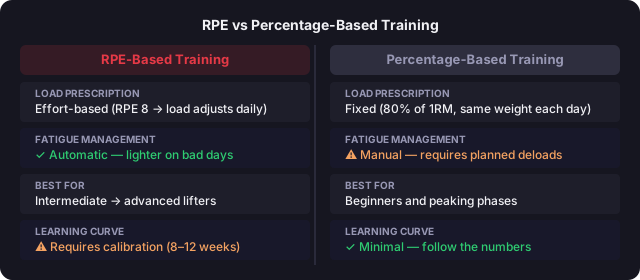
Percentage-based programming starts with your tested or estimated 1-rep max and builds sessions around fixed proportions of that number. A typical week might look like this: Monday, squat 3×5 at 80%. Wednesday, 4×3 at 85%. Friday, 3×3 at 87.5%. The math is done in advance. You show up, hit the numbers, log it, go home.
The advantages are real. You always know exactly what weight to use. Progress is visible and trackable, if your 1RM goes up by 10 lbs over a 12-week block, the program worked. Beginners love this because it removes decision fatigue. There's no subjective guesswork about effort level; the spreadsheet tells you what to do.
The problem is that your 1RM is a snapshot, not a constant. The percentage you calculated after a well-rested weekend test looks nothing like the number you're capable of after three poor nights of sleep mid-block. A session where 80% feels like a true 80% is very different from one where it grinds like 90%. Percentage-based programs can't see that. They prescribe the same load regardless of how you feel today.
How RPE-Based Training Works
RPE training prescribes the effort level, not the weight. Instead of "squat 3×5 at 80%," your program says "squat 3×5 at RPE 8." You determine the weight each day based on how the bar feels during warm-ups. RPE 8 means 2 reps left in the tank, so you load until a set of 5 leaves you with exactly 2 reps remaining.
This means that on a great day, you might squat 250 lbs for 5 reps at RPE 8. On a rough day, the same RPE 8 might only call for 220 lbs. The intensity of effort is constant; the weight adjusts to match it. That's autoregulation in its simplest form.
Try our RPE calculator to see how this plays out with your own numbers. Enter any weight-reps-RPE combination and you'll get your estimated 1RM alongside recommended weights for your next session.
The Research Case for RPE
A 2016 study by Eric Helms and colleagues in the Journal of Strength and Conditioning Research showed that lifters using RPE-based loading achieved comparable strength gains to those on percentage programs, while reporting lower perceived training stress. A 2021 review in Sports Medicine found that autoregulation approaches (of which RPE is the most common) are particularly effective for intermediate and advanced lifters who have accumulated enough training history to calibrate their effort accurately.
The NSCA's Essentials of Strength Training and Conditioning dedicates significant space to autoregulation methods, noting that they help athletes manage fatigue accumulation more effectively than fixed-load programming across long training blocks.
Where Percentage Training Still Wins
None of this means percentage-based programming is obsolete. It remains the better choice in several situations.
For complete beginners, effort perception isn't reliable yet. A beginner squatting for the first three months genuinely can't tell the difference between RPE 8 and RPE 10, the unfamiliar movement pattern and general lack of training history make calibration nearly impossible. A program like Starting Strength or GZCLP gives beginners a clear roadmap without demanding accurate self-assessment.
For simple record-keeping, percentages are hard to beat. You can look at a training log from six months ago and immediately know the absolute load. RPE logs require more context to interpret.
For highly structured competition preparation, some elite coaches prefer percentage-based peaking in the final 4–6 weeks before a meet, where the athlete's 1RM is well-known and the goal is to groove specific attempts at specific loads.
The Hybrid Approach Most Elite Lifters Use
Data from Reactive Training Systems, Barbell Medicine, and similar coaching organisations points to something most lifters eventually figure out on their own: successful competitive powerlifters rarely pick one method and stick with it exclusively. They use percentage-based frameworks to structure the whole training block (hypertrophy phase, strength phase, peaking phase) and use RPE to govern day-to-day loading within those blocks.
The prescription might read "work up to a heavy set of 3 at RPE 9, then back off 10% for two sets of 5 at RPE 7–8." Percentage gives the structure; RPE gives the flexibility. This combination keeps training specific while accounting for daily variability.
To run this kind of hybrid approach, you need to estimate your 1RM regularly. Our powerlifting RPE calculator makes that calculation instant, enter any working set and get a projected 1RM alongside recommended loads for your next session at RPE 7 or 8.
Which Should You Choose?
If you've been lifting seriously for less than a year, start with a structured percentage-based program. Build the movement patterns, accumulate base strength, and get a reliable tested 1RM. Then start layering in RPE awareness, rate every set, compare your predictions to actual failure points, and build your calibration database.
If you've been training consistently for two or more years, RPE-based programming will almost certainly serve you better. Your effort perception is accurate enough to make it reliable, and the daily adaptability it provides becomes increasingly valuable as fatigue management gets harder.
If you're preparing for a specific competition, talk to a coach who understands both systems. The final 6–8 weeks before a meet typically benefit from tighter control, but RPE-based training through the general preparation phase sets you up with better fatigue management going in.
Which Approach Wins Long-Term?
Think of percentage training as a map and RPE training as a compass. Maps work when you know the terrain precisely. Compasses win when the terrain shifts under you, which, with human performance, it always does. Learn both systems. Apply whichever one matches the training situation in front of you.
Before your next heavy session, run one of your recent working sets through the RPE calculator on our homepage to see your projected 1RM and your recommended RPE 7 and RPE 8 loads for the next session.