Quick Answer
Strength training zones are intensity ranges defined as percentages of your 1-rep max: Maximal Strength (≥95%), Heavy Strength (85–95%), Moderate Strength (75–85%), Hypertrophy (65–75%), and Endurance/Technique (<65%). Each zone produces different adaptations and requires different programming strategies.
Why Training Zones Matter
Put 20 experienced lifters in a gym and they'll all have opinions about reps and sets. What most of them don't have is a clear framework for understanding why different rep ranges and loads produce different results. Training zones provide that framework. They connect the weight on the bar (expressed as a percentage of your 1RM) to the physiological adaptations you'll get from training there.
The zones used in this article are derived from guidelines published by the National Strength and Conditioning Association (NSCA) and are consistent with how competitive powerlifters, Olympic weightlifters, and strength coaches have organized training periodisation for decades.
Our RPE calculator shows your current training zone automatically after every calculation. If you're not sure which zone you're working in, that's your first step.
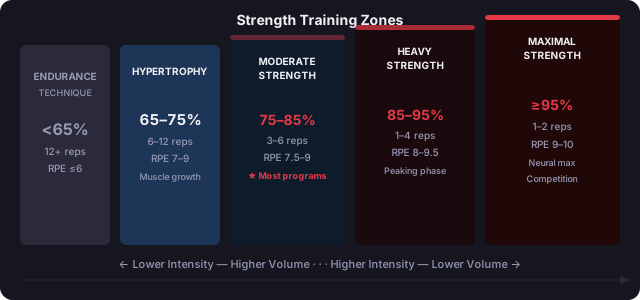
Zone 1: Maximal Strength (≥95% of 1RM)
At 95% or above, you're in near-maximal territory. Rep counts drop to 1–2 per set. The primary adaptation here is neural; you're training your nervous system to recruit maximum motor units simultaneously, not just building muscle tissue.
Who trains here: Competitive powerlifters and Olympic weightlifters in competition preparation. Athletes who need to express absolute maximum strength on a platform.
Programming: Very low volume (3–6 total reps per session), very long rest periods (5–8 minutes), and typically only 1–2 sessions per lift per week. The intensity is so high that frequency must be managed carefully to allow nervous system recovery.
RPE context: Singles in this zone land at RPE 9–10. Anything below RPE 8.5 at ≥95% would suggest your 1RM is significantly higher than you've measured, time to test.
Pitfalls: Training too often at ≥95% leads to rapid central fatigue accumulation. Most intermediate lifters have no business spending more than 10–15% of their training volume in this zone. Save true max-effort training for peaking phases and competition day.
Zone 2: Heavy Strength (85–95% of 1RM)
This is the primary strength development zone. Rep counts run 1–4, loads are heavy but manageable for multiple sets, and the stimulus for increasing maximal strength is strong.
Who trains here: Intermediate to advanced lifters focused on strength expression. Competition lifters during their strength block, 4–8 weeks out from a meet.
Programming: 3–5 sets of 1–3 reps, rest periods of 3–5 minutes. Total session volume should be lower than hypertrophy zones, quality over quantity.
RPE context: Well-executed sets in this zone typically land at RPE 7.5–9, depending on the rep count and where you are in a training cycle. A heavy single at 90% should move at RPE 8.5–9 when you're fresh.
NSCA guideline: For maximal strength development, the NSCA's Essentials of Strength Training and Conditioning recommends 1–6 reps at 85–100% of 1RM, with ≥3 minutes rest. The 85–95% range specifically allows for enough volume per session to accumulate an effective training stimulus without the extreme fatigue of true maximal singles.
Zone 3: Moderate Strength (75–85% of 1RM)
This is the most broadly applicable training zone and the one most lifters spend the bulk of their productive training in. It's heavy enough to drive strength adaptations but light enough to allow meaningful volume, the combination that builds the base of strength under competition-weight performance.
Who trains here: Everyone from late-stage beginners to competitive athletes. This zone is the bread and butter of most evidence-based strength programs.
Programming: 3–5 sets of 3–6 reps, rest periods of 2–4 minutes. Volume can be relatively high compared to the heavy and maximal zones, which is why this range drives the most long-term strength gains for most populations.
RPE context: At 80% for a set of 5, expect RPE 7.5–8.5 depending on the exercise and your training state. This is also where the Brzycki formula (used in our 1RM calculator) is most accurate.
Zone 4: Hypertrophy (65–75% of 1RM)
The hypertrophy zone is characterised by moderate loads and moderate-to-high rep ranges (6–12 reps per set). The research, particularly work by Dr. Brad Schoenfeld at Lehman College, consistently shows that muscle growth occurs across a wide range of rep counts when sets are taken close to failure, but the 65–75% range with sets of 6–12 reps represents the most efficient combination for most lifters.
Who trains here: Lifters in general preparation phases (off-season), bodybuilders, and anyone whose primary goal is increasing muscle mass. Even competitive powerlifters run hypertrophy blocks in the offseason to build the raw muscle that will later be expressed as strength.
Programming: 3–5 sets of 6–12 reps, rest periods of 1.5–3 minutes. Total volume (sets × reps × load) should be higher than strength zones. Proximity to failure (RPE 7–9) is more important than the exact percentage.
Key insight: A 2021 meta-analysis in the Journal of Strength and Conditioning Research found that hypertrophy is nearly equivalent across the 6–30 rep range when equated for effort (proximity to failure). The 65–75% / 8–12 rep range is practical and efficient, but it's not magic.
Zone 5: Endurance and Technique (<65% of 1RM)
Below 65%, the load is too light to drive meaningful strength or hypertrophy adaptations in trained lifters. This zone is reserved for two purposes: muscular endurance training (high-rep circuit work, conditioning) and technical practice where load is kept light specifically to allow focus on movement quality.
Who trains here: Beginners learning movement patterns, experienced lifters doing warm-up and technique work, and athletes in active recovery periods.
Programming note: If your working sets frequently land below 65% of your 1RM, either your programming is too conservative or your 1RM estimate is significantly understated. Run your numbers through our RPE calculator to verify your current estimated 1RM.
How to Use Training Zones in Your Program
The key principle is periodisation: shifting emphasis between zones based on where you are in your training cycle.
Offseason / General Preparation: Prioritise Zones 3 and 4 (75–85%, some hypertrophy work). Build muscle, accumulate volume, keep intensity moderate.
Pre-competition / Specific Preparation: Shift emphasis to Zones 2 and 3 (85–95%, 75–85%). Volume drops, intensity climbs. Sessions get harder but shorter.
Peaking (4–6 weeks pre-meet): Zone 2 dominates with some Zone 1 exposure. Singles and doubles at 90%+. Volume very low.
Post-competition / Transition: Drop into Zones 4–5 for active recovery and technique maintenance. Let the nervous system recover before the next training block begins.
Understanding which zone you're working in and why, turns programming from guesswork into deliberate practice. Every time you calculate your RPE with our training load calculator, you're not just getting a number. You're seeing exactly where on this spectrum your training currently sits.