Quick Answer
The most common RPE mistakes are: rating too late (after rest), ego inflation (rating light as heavy), confusing technical and muscular failure, not accounting for fatigue accumulation between sets, applying one standard across all exercises, rating warm-ups too high, and never validating against actual maxes.
RPE Mistakes Cost You Real Gains
Bad RPE calibration doesn't just give you inaccurate numbers; it systematically derails your training. Overrated RPE means you're chronically underloading. Underrated RPE means you're grinding harder than prescribed without knowing it, accumulating fatigue faster than your program anticipates. Either way, the autoregulation system that's supposed to make your training smarter is working against you.
These are the seven mistakes that appear most consistently in lifters who struggle with RPE-based programming.
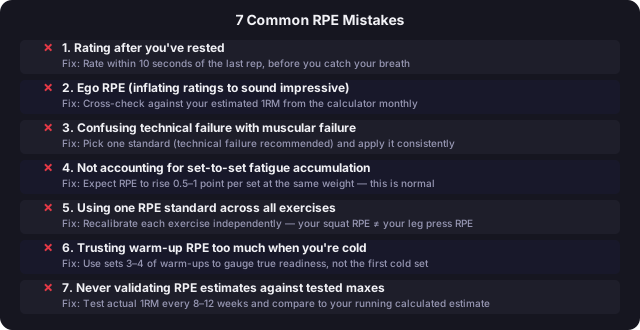
Mistake 1: Rating RPE After You've Rested
This is the single most common calibration error, and it happens to almost everyone who doesn't deliberately guard against it. You complete a hard set, stand up, catch your breath for 30–60 seconds, and then think back to how hard it was. By that point, the discomfort has faded. The set feels easier in memory than it was in reality. You write down RPE 7.5 for something that was genuinely RPE 8.5.
The fix: Rate your RPE before you unrack or while you're still bent over after a deadlift. Write it down or say it out loud within 10 seconds of the last rep. If you're using our RPE calculator, enter the numbers immediately, don't wait until the end of the session.
Mistake 2: Ego RPE (Making Light Sets Sound Heavy)
Some lifters inflate their RPE ratings, consciously or not, to make their training sound more impressive or to justify lower loading in their log. If 135 lbs on the bench "feels like RPE 8" week after week, something's wrong, either your 1RM is drastically lower than you think, or you're not rating honestly.
The fix: Once a month, verify your RPE ratings against a tested max or near-maximum effort. Our Reps in Reserve calculator will tell you your estimated 1RM from any set. If you're rating your 155 lb × 5 bench as RPE 8, the calculator should show an estimated 1RM of around 185–195 lbs. If you know your actual max is closer to 225 lbs, your RPE ratings are inflated by 1–2 full points.
Mistake 3: Confusing Technical Failure With Muscular Failure
These are two different failure points, and mixing them up wrecks your calibration. Technical failure means your form breaks down; your back rounds on a deadlift, your elbows flare uncontrollably on bench, depth becomes inconsistent on squat. Muscular failure means the muscle literally cannot produce enough force to complete the concentric.
On compound lifts, technical failure almost always comes first; you'll break form before you reach true muscular failure. If you're defining RPE 10 as "I broke form and stopped," you're reaching that point with more muscular capacity remaining than someone who defines it as absolute failure.
The fix: Pick one standard and apply it consistently. For compound lifts, most evidence-based coaches recommend using technical failure as the standard, it's safer and more practically relevant. Absolute muscular failure is best reserved for isolation exercises where breaking form doesn't cause injury.
Mistake 4: Not Accounting for Set-to-Set Fatigue
Many lifters rate their first working set accurately, then expect subsequent sets at the same weight to also hit the target RPE. They don't. Fatigue accumulates between sets, especially in compound movements with heavy loads and short rest periods. Your third set of squats at the same weight will always feel harder than your first, not because you're weaker, but because accumulated metabolic and neuromuscular fatigue is adding to the perceived effort.
The fix: Expect your RPE to rise 0.5–1 point per set when holding the same weight. If your first set at 275 lbs is RPE 8, your third set at the same weight will likely feel like RPE 8.5–9. This is normal and doesn't mean you need to drop weight; it means your total fatigue accumulation for the session is appropriate. If the later sets are regularly hitting RPE 10 when the first was RPE 8, your programming is asking for too many sets at too high an intensity.
Mistake 5: Using One RPE Standard Across All Exercises
Your RPE calibration for a barbell squat does not transfer to a seated leg press, a Romanian deadlift, or a goblet squat. Movement pattern familiarity, stability demands, and the nature of the failure point differ significantly between exercises. A lift you've been doing for 3 years has a well-developed RPE sense; a movement you added last month probably doesn't.
The fix: Build your RPE library exercise by exercise. When adding a new movement to your programming, spend 4–6 weeks treating your RPE ratings as approximate and compare them against the actual number of reps you can complete before stopping. The recalibration period is shorter for exercises similar to ones you already rate accurately and longer for genuinely novel movements.
Mistake 6: Rating Warm-Up Sets Too High
Warm-up sets create a priming effect, later sets feel easier because your nervous system, muscles, and connective tissue are better prepared. But the reverse is also true: when you're cold and fatigued from a long day, early warm-up sets can feel genuinely hard. A 50% set that should be RPE 4–5 gets rated as RPE 7 because your back is tight and your joints haven't warmed up yet.
If you carry that inflated feeling into your working set selection, you'll underload for the session.
The fix: Treat warm-up RPE ratings with skepticism. The rule of thumb: if your warm-ups are rating 2+ points higher than historical baseline, your readiness is genuinely low, adjust your working weights accordingly. If your warm-ups feel fine after 2–3 sets despite feeling rough initially, trust the later warm-ups to set your working weight.
Mistake 7: Never Validating Against Actual Maxes
This is the long-term version of most other mistakes on this list. Lifters who train exclusively by RPE without ever testing actual maxes drift off calibration and don't notice. The estimated 1RM generated by the homepage calculator is excellent for tracking trends, but it still needs occasional ground-truth validation against a real tested max.
The fix: Test your actual 1RM (or a reliable 3RM or 5RM) every 8–12 weeks under controlled conditions. Compare it to the average of your recent estimated 1RMs from training. A gap of more than 7% in either direction suggests your calibration has drifted and needs recalibration using the methods in our RPE calibration tips guide.
For most people reading this, one or two of these mistakes will feel immediately familiar. Fixing them doesn't require starting over, just a few sessions of deliberate practice with immediate logging and honest self-assessment. The payoff is autoregulation that actually works: training sessions calibrated to what you can handle today, not what you could handle on your best day last month.