Quick Answer
The fastest ways to improve RPE calibration: push occasional sets to actual failure to build your reference point, rate effort immediately (before rest), log every set, cross-reference with bar speed, and validate your estimates quarterly with tested maxes.
Why Calibration Is the Whole Game
RPE-based training is only as good as your RPE ratings. If you consistently call a set RPE 8 when it was genuinely RPE 9, you'll chronically underload and never understand why your progress has stalled. If you inflate ratings in the other direction, you'll overtrain without a clear signal from the data.
The good news: calibration is a trainable skill. Most lifters see significant improvement within 6–8 weeks of deliberate practice. Here are the five most effective methods.
1. Test to Failure, Deliberately
Most lifters never actually push a set to true failure. They stop when it feels hard, call it RPE 9, and move on. But if you've never experienced genuine failure, you have no reliable anchor point for anything below it.
Once every 4–6 weeks, on a low-stakes isolation exercise (something unlikely to cause injury at failure, like a dumbbell curl, leg press, or machine row), push a set to absolute muscular failure. Count the total reps. Now look back at the rep before that final failed rep, that's what RPE 10 actually feels like for you.
Compare that to your recent RPE 8 ratings on similar exercises. If your RPE 10 failure set was 12 reps and you've been calling your 10-rep sets RPE 8, you're calibrated correctly. If you've been calling 10-rep sets RPE 8 but only got 11 reps to failure (not 12), you've been underrating; you only had 1 rep left, not 2.
Important: do this on exercises where failure is safe and controlled, not on barbell squats or bench press without a spotter.
2. Rate Immediately After the Set
Perceived effort fades quickly. Research on effort perception shows that just 60 seconds of rest is enough to significantly lower a lifter's retrospective RPE rating of a set. You feel better, the discomfort eases, and the set feels easier in memory than it was in reality.
Make it a rule: rate your RPE before you catch your breath. Write it down or type it into your log within 10 seconds of completing the last rep. This sounds small, but it eliminates a consistent source of rating deflation that affects almost every lifter who doesn't practice immediate logging.
If you're using our RPE calculator to track estimated 1RM, the same discipline applies, plug in the numbers immediately after the set, not at the end of the session.
3. Cross-Reference With Bar Speed
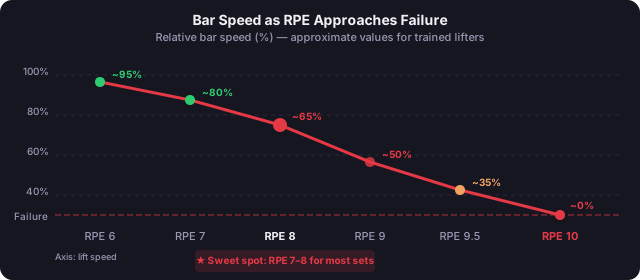
Bar speed is a proxy for effort. As a set approaches failure, bar speed drops and experienced lifters learn to read this relationship. If your last rep moved noticeably slower than your first, you're likely at RPE 8.5 or higher. If all reps moved at roughly the same speed, you're probably at RPE 7 or below.
You don't need a velocity tracker (though tools like GymAware or Push Band can help). You can develop this skill by simply paying attention. After each set, mentally note the bar speed on the last rep relative to the first. Over time, you'll build an internal library of what "2 reps left" versus "4 reps left" looks and feels like.
If you have access to a velocity tracker, a few training sessions with it can dramatically accelerate calibration. The data gives you immediate objective feedback on effort that raw perception can't provide.
4. The Pause-Before-Last-Rep Test
This is a technique some RPE-trained coaches use to help their lifters build real-time calibration:
After completing a set, before you log the RPE, ask yourself: "Right now, if I had to do one more rep, could I do it cleanly?" If the answer is "definitely yes," you're at RPE 8 or lower. If the answer is "maybe, with a grind," that's RPE 9. If the answer is "no," you're at RPE 10.
This forces you to evaluate your remaining capacity at the moment it matters most, not in retrospect when fatigue has eased. It turns an abstract scale into a binary question that's much easier to answer honestly.
Practice this mental check every single set, including warm-ups. Over 4–6 weeks, the habit becomes automatic and your in-set awareness sharpens noticeably.
5. Validate Quarterly Against Tested Maxes
The final calibration check is simple: every 8–12 weeks, test your actual 1RM under controlled conditions. Compare it to the estimated 1RM you've been generating from your training sets via our Reps in Reserve calculator.
If your training-derived estimates consistently overshoot your tested max (e.g., calculator says 315 lbs estimated 1RM but you actually maxed 290 lbs), you're overrating your RPE; you think you have fewer reps remaining than you actually do. Your working weights have been too light relative to your true capacity.
If your estimates consistently undershoot your tested max, you're underrating, setting more conservatively than you realised. Your working weights might be appropriate, but your effort ratings don't reflect them accurately.
Either way, the discrepancy is useful. Apply a correction factor to your future estimates: if your calculator-derived 1RM is consistently 7% too high, multiply future estimates by 0.93. Then address the calibration error at its source using the methods above.
Most well-calibrated intermediate lifters see their estimated 1RM land within 5% of their tested max. That's the target. You get there through consistent logging, immediate ratings, and occasional reality checks against actual maxes. The calculator on our homepage is the fastest way to begin, the data builds itself once the habit is in place. If you're just getting started with the RPE scale, start with our beginner's guide to RPE before running your working sets through the calculator.