Quick Answer
For hypertrophy, target RPE 7–9 on sets of 6–15 reps. Proximity to failure is the key driver of muscle growth, RPE tells you how close you're getting. Aim for at least 2–3 sets per exercise where the last 2–3 reps feel genuinely challenging (RPE 8–9).
Why RPE Matters for Muscle Building
RPE gets associated almost exclusively with powerlifters chasing 1-rep maxes, and that's a mistake. The same scale that helps a 600 lb squatter pick his competition opener is just as useful for a bodybuilder trying to add ten pounds of muscle. The logic is identical in both cases: proximity to failure is the variable that drives the adaptation.
For hypertrophy, the research is unambiguous. A 2021 meta-analysis by James Krieger, one of the most detailed meta-analyses of resistance training and muscle growth, concluded that sets taken close to failure (within 3–4 reps of muscular failure) produce significantly more hypertrophy than sets stopped far from failure, regardless of load. RPE is just a way to quantify how close to failure you're getting and to make sure you stay in the right range consistently.
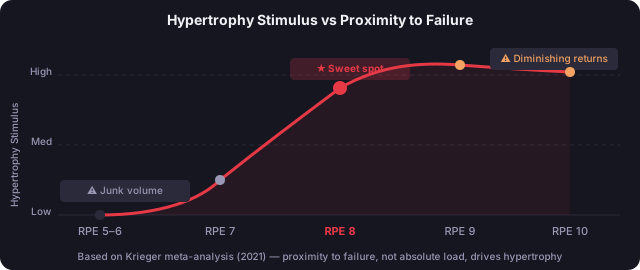
The Hypertrophy RPE Target Zone
Based on current evidence, the optimal hypertrophy zone for most exercises and rep ranges is RPE 7–9. Translated into what that actually feels like on each set:
RPE 7 (3 reps in reserve): The set feels genuinely challenging, but you're confident you could do 3 more clean reps. This is the lower boundary of effective hypertrophy stimulus for most intermediate lifters. It's appropriate for first sets, accessory exercises, or sessions where fatigue is already high.
RPE 8 (2 reps in reserve): This is the sweet spot for hypertrophy. You worked hard, the last few reps required real effort, and you had just enough reserve to maintain good form. Most of your working sets should land here.
RPE 9 (1 rep in reserve): Reserve this for final sets or intensity techniques (drop sets, rest-pause). Doing multiple sets at RPE 9 generates a lot of fatigue for the additional stimulus it provides, not always the best trade-off across a full session.
RPE 10 (failure): Research by Dr. Brad Schoenfeld suggests that training to absolute failure offers minimal additional hypertrophy benefit over stopping at RPE 9, while significantly increasing recovery requirements and injury risk. Save true failure for isolation exercises on final sets only.
Why Junk Volume Is the Hypertrophy Killer
Junk volume, sets that are too easy to drive adaptation, is the most common mistake lifters make in hypertrophy training. They go through the motions, hit their prescribed reps, and wonder why they aren't growing.
The mechanism for hypertrophy is mechanical tension on muscle fibers, and that tension only reaches the threshold needed to trigger adaptation in the reps closest to failure. A set of 12 reps at RPE 6 means you did 12 easy reps, most of which generated insufficient tension for a growth signal. A set of 12 at RPE 8 means you did 10 reps building toward a hard last two, the stimulus that actually matters.
Use our RPE calculator after each set to check where you're landing. If your estimated 1RM is coming out unusually low for your exercise history, you're likely rating your RPE too high and the sets are easier than you think, time to add weight.
RPE for Compound vs Isolation Exercises
The RPE calibration process feels different for compound and isolation movements:
Compound lifts (squat, deadlift, bench, row): RPE ratings are most reliable here because these movements have a clear, definable failure point. You can't complete the concentric phase. The homepage RPE calculator works best with compound movements, stick to squat, bench, deadlift, and heavy row sets when you're tracking trend data.
Isolation lifts (curls, lateral raises, leg extensions): These are harder to rate because fatigue feels diffuse, the muscle burns, breathing gets labored, form may drift, but the "failure" point is less clear-cut. For isolation exercises, aim for RPE 8–9 based on the feel of the last few reps rather than strict mechanical failure assessment. The Brzycki formula is less accurate for isolation movements, so don't rely on the 1RM estimate output as heavily.
Practical Hypertrophy Programming With RPE
A sample hypertrophy session layered with RPE targets looks like this:
Main compound lift (e.g., barbell row):
Primary accessory (e.g., dumbbell row):
Secondary accessory (e.g., face pulls, rear delt fly):
The key principle: track your RPE every set. If multiple sets are landing below RPE 7, add weight. If they're consistently hitting RPE 9+ across all sets early in the session, you're loading too heavy, back off and save the high-intensity work for the final set or two.
Tracking Hypertrophy Progress With RPE
Strength is the most reliable proxy for hypertrophy in drug-free athletes. As you get bigger, you get stronger. Tracking your estimated 1RM across a hypertrophy block with the Reps in Reserve tool gives you a leading indicator of muscle growth, one that shows up weeks before the mirror or the scale catches up.
If your estimated 1RM on your main compound lifts rises by 5–10% over an 8–12 week hypertrophy block, you've almost certainly added meaningful muscle. If it's flat, your nutrition, sleep, or training intensity needs attention.
For more on the underlying training zones and what percentage of 1RM the hypertrophy zone covers, read our training zones guide. For a full breakdown of RPE versus fixed-percentage approaches for building muscle, see RPE vs percentage training.