Quick Answer
RPE calibrates differently across the big three. Deadlifts tend to feel harder and are rated higher than squats and bench at the same relative load. On squats, RPE is most reliable at 3–5 reps. Bench press RPE is often underrated by beginners due to spotters and safety rails. Deadlift RPE fluctuates most with daily energy levels.
Why the Big Three Need Different RPE Approaches
The squat, bench press, and deadlift share a common programming language, but they don't share the same RPE calibration. The mechanics, muscle mass involved, fatigue patterns, and failure modalities differ enough between them that your RPE 8 squat triple and your RPE 8 deadlift triple are two very different physiological events and should be programmed accordingly.
Understanding these differences helps you rate each lift more accurately and design programming that reflects the actual demands of each movement.
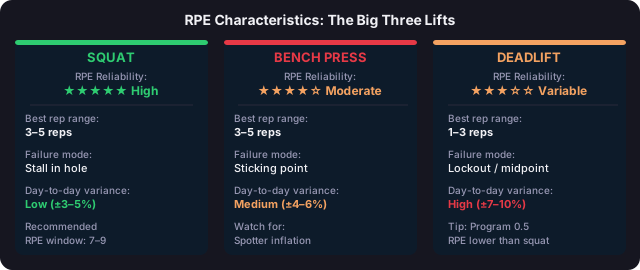
Squat: The Most Reliable RPE Signal
The barbell squat is generally considered the most consistent movement for RPE calibration among trained powerlifters. The failure mode is predictable (you stall in the hole or can't stand up), the muscle groups involved are large, and the movement pattern is practiced frequently enough that most intermediate lifters develop strong RPE awareness.
Key squat RPE characteristics:
At RPE 8 for a set of 3 reps, your last rep should feel like it required a genuine acceleration effort but moved without grinding. Bar speed is noticeably slower than rep 1, but not dramatically so. You're confident you could do 2 more clean reps.
At RPE 9 for a set of 3, the third rep grinds noticeably. Bar speed drops significantly on that rep. You're confident you could get 1 more, but it would be a true fight.
Where squatters go wrong with RPE:
High-rep squat sets (8–12 reps) are harder to rate than low-rep sets because fatigue accumulates unpredictably and breathing becomes the limiting factor before muscular capacity does. For sets above 6 reps, treat your RPE rating as approximate, ±0.5 from reality is a realistic margin.
Programming note: For squats, working sets at RPE 8 typically land in the 75–85% of 1RM range when you're fresh. Drop your squat working sets into the RPE calculator on our homepage and watch your estimated 1RM track across a full training block, the trend tells a clearer story than any single session.
Bench Press: The Underrated Lift
Bench press RPE calibration suffers from a unique problem: most lifters train it with a spotter or in a rack, and the psychological presence of a safety net makes sets feel more manageable than they would unspotted. Research on the spotter effect suggests that simply having a spotter present can reduce perceived effort, meaning your RPE 8 benchon a spotter day might be an RPE 8.5 rating if you were alone.
Key bench press RPE characteristics:
The bench press failure point is clearer than the deadlift but potentially more dangerous, which affects how close to failure most lifters are willing to push in training. This means bench RPE data, on average, comes from sets slightly further from failure than squat or deadlift data.
At RPE 8 for a set of 5 reps, the last rep should feel challenging but controlled. Leg drive remains active, back arch is maintained, and bar path is straight. If any of those form elements break down, you've reached technical failure, which most bench programmers define as the upper boundary.
The bench-specific sticking point issue: Bench press has a clear mechanical sticking point (1–2 inches off the chest as the bar transitions from pec-dominant to anterior delt-dominant). A set might feel like RPE 7.5 through the first four reps and then hit a sudden RPE 9.5 on rep five if that rep passes through the sticking point. This non-linearity makes bench RPE more variable than squat.
Programming note: For bench press, verify your RPE estimates by comparing your estimated 1RM from our Reps in Reserve calculator against periodic 3RM or 5RM tests. If your calculator-derived 1RM consistently overestimates your tested max by more than 7%, your bench RPE ratings are inflated; you're stopping further from failure than you realise.
Deadlift: The Most Demanding RPE Rating
The deadlift is both the strongest and the most fatiguing of the three competitive lifts, and this has significant implications for RPE calibration.
The deadlift fatigue problem: Deadlifts produce more systemic (central) fatigue per set than squats or bench at the same relative intensity. A deadlift session at RPE 8 × 3 × 5 sets is more taxing than the equivalent on squat or bench, even if the absolute load is higher on squat. This means that if you program all three lifts at the same RPE targets with the same volume, your deadlift sessions will accumulate disproportionate fatigue.
Day-to-day variability: The deadlift's large muscle mass recruitment makes it highly sensitive to daily energy levels. Many experienced powerlifters report that their deadlift 1RM varies by 7–10% day-to-day, more than squat or bench. This means your estimated 1RM from deadlift sets will fluctuate more than your other lifts, and your RPE data will show more session-to-session variance. That's not calibration error, it's real variability in the lift.
Key deadlift RPE characteristics:
At RPE 8 on a deadlift triple, the last rep should feel like a genuine effort where the bar speed drops but you clearly had 2 more reps in you. Hip extension should complete fully, lockout clean. If the bar slows dramatically or your lower back rounds under load, you've hit technical failure, treat that as RPE 10 regardless of how many more reps you could have completed with compromised form.
Programming note: Most coaches recommend running deadlift volume at 0.5–1 RPE point lower than squat and bench to account for its higher fatigue cost. If your program says RPE 8 for all three lifts, consider interpreting the deadlift target as RPE 7.5.
The Universal RPE Guidelines for All Three Lifts
Test your RPE calibration regularly. Every 8–12 weeks, pick a day when you're fresh and test a 3RM or 5RM on each lift under controlled conditions. Run those results through our powerlifting RPE calculator to compare your tested performance to your training-derived estimates.
Keep lift-specific logs. Your squat RPE history should be tracked separately from your bench and deadlift histories. The same weight that's RPE 8 on a heavy squat day is not directly comparable to an RPE 8 on bench. They live in different datasets.
Use the calculator consistently. The most valuable thing you can do is plug in every significant working set, squat, bench, and deadlift, into a single tracking system. Over 8–12 weeks, three separate estimated 1RM trendlines emerge, one per lift. Rising trends signal progress; flat or declining trends signal a programming or recovery issue worth addressing before it becomes a plateau. Get started with our free RPE calculator today and start building your lift-specific RPE library.
For more on how RPE calibration works and common mistakes to avoid, see 7 Common RPE Mistakes and our complete beginner's guide to RPE training.